


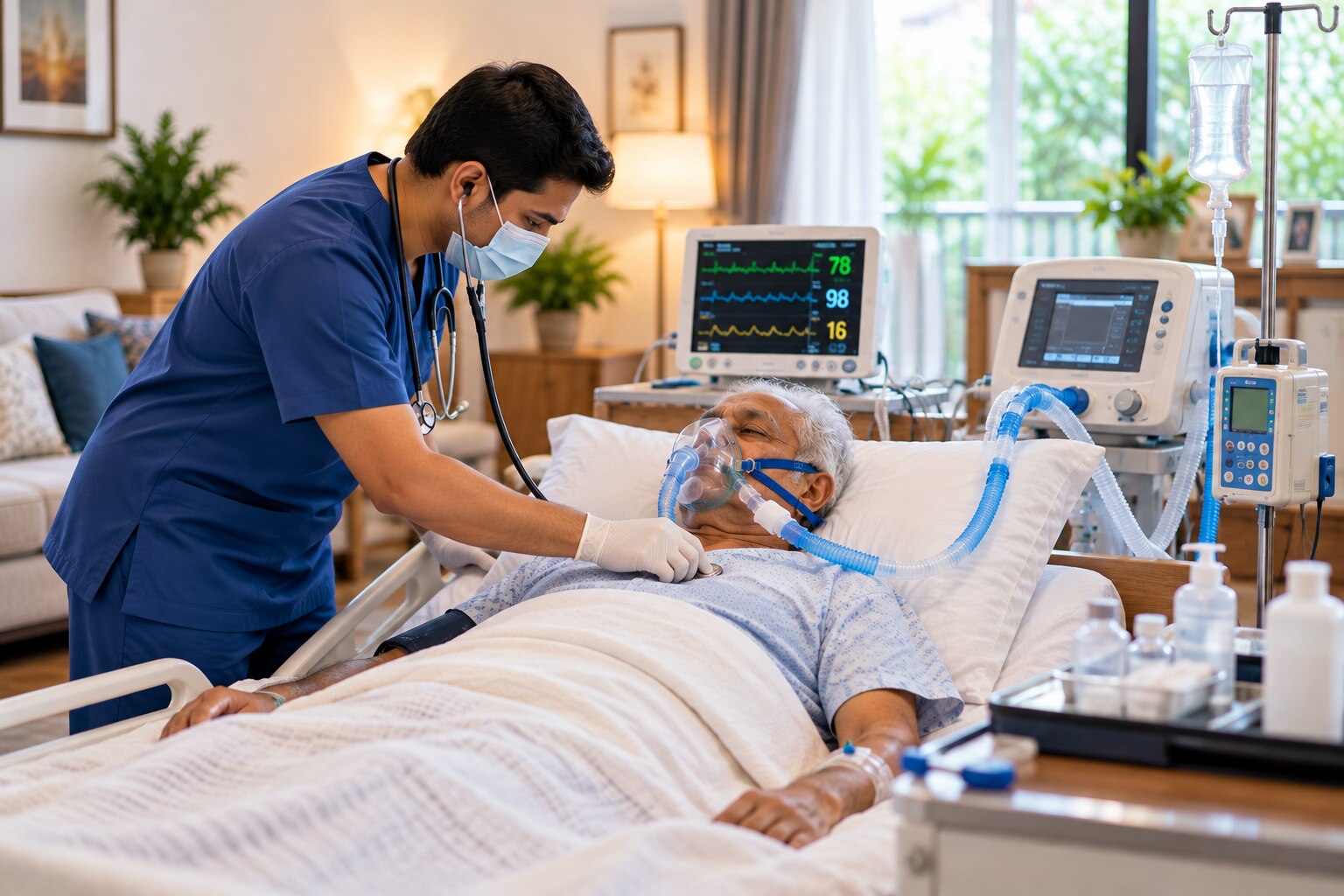
Serious illness does not automatically make home care safe, and a hospital-level label does not guarantee hospital-level capability in a house. You will learn how to judge eligibility, identify emergencies, check the setup and staffing, and compare a clinical home-care service with equipment-only support.
Key takeaways
- Treat sudden deterioration as an emergency, not a home-care problem.
- Confirm the patient is stable enough for planned care at home.
- Require backup power, oxygen, suction, monitoring, and an escalation plan.
- Compare staffing, response times, documentation, and equipment maintenance records.
What critical care at home means—and when home is unsafe
Critical care at home supports a patient who needs close observation, complex treatment, or technology such as oxygen, a ventilator, infusion pumps, suction, or feeding access, but is stable enough for a planned home setting. The home ICU meaning is planned intensive support, not a substitute for emergency treatment.
| Service | What it means |
|---|---|
| Routine home nursing versus critical care nursing service at home | Routine home nursing handles scheduled basic clinical tasks; critical care nursing manages complex treatment, close monitoring, and rapid escalation. |
| Post-discharge care | Supports recovery after hospitalization, such as medicines, wound care, and rehabilitation. |
| Palliative care | Relieves symptoms alongside treatment for serious illness. |
| Hospice care | Focuses on end-of-life comfort under eligibility rules. |
Clinical instability means a change in breathing, circulation, consciousness, seizure activity, bleeding, or vital signs that needs rapid intervention. Home is unsafe during severe breathlessness, new chest pain, blue lips, sudden weakness or confusion, uncontrolled bleeding, repeated seizures, or unresponsiveness.
- Call emergency services or arrange an appropriately equipped ambulance for any of these emergencies.
- Seek urgent help when oxygen saturation remains low despite prescribed oxygen.
- Do not increase oxygen without clinical direction, especially for someone with chronic hypercapnic COPD.
A pulse-oximeter reading never replaces assessment of work of breathing, skin colour, mental status, and chest symptoms. Poor circulation, cold fingers, movement, nail products, incorrect probe placement, and delayed readings can mislead you. A home-care team may provide escalation instructions, but scheduled visits and “24/7 support” do not equal continuous bedside emergency care.
How to decide whether a patient is suitable for home critical care
Home ICU eligibility depends on stability, capability, and a written plan—not on the family’s preference alone. Complete a home critical-care assessment before transport, with the treating clinician documenting:
1. Diagnosis, prognosis, and expected duration of support; current blood pressure, pulse, respiratory rate, temperature, and oxygen saturation; prescribed oxygen flow or ventilator settings; airway type and secretion burden; consciousness level; feeding route; mobility and pressure-injury risk; infection status; complete medicines and allergies.
2. Whether hospital care is safer under hospital versus home care. Keep the patient in hospital when they need emergency surgery, continuous dialysis, blood products, invasive procedures, advanced imaging, isolation, or rapid access to multiple specialists. These needs can exceed what a home team can provide safely.
3. An individualized written plan stating clinical goals, monitoring thresholds, visit or shift frequency, medicines, equipment, escalation instructions, the treating clinician’s review schedule, and who remains responsible between visits. “24/7 support” does not prove continuous bedside observation.
Match medical transport for critical patients to clinical needs, not distance. Oxygen, cardiac monitoring, airway management, ventilator support, or medication infusions determine the ambulance and crew capability. A ventilated patient may need a clinician trained in airway emergencies and manual ventilation during transit.
If the patient deteriorates before departure, stop the transfer and call emergency services. A planned home service cannot replace immediate hospital treatment.
What a safe home ICU setup contains—and who is responsible for it
A safe home ICU begins with a written home ICU equipment list, matched to the patient’s prescription and reviewed by a clinician. Each device needs a named owner for supply, installation, calibration, cleaning, servicing, replacement, and removal.
- Electric hospital bed: positions the patient safely; a pressure-relieving mattress reduces pressure-injury risk.
- Prescribed oxygen source plus backup: supports breathing during treatment and outages.
- Suction machine: removes secretions that obstruct the airway.
- Patient monitor: tracks prescribed parameters such as oxygen saturation, pulse, blood pressure, and respiratory rate.
- Infusion or syringe pumps: deliver fluids and medicines at controlled rates.
- Ventilator when ordered: provides mechanical breathing support and needs backup procedures.
- Nebulizer: delivers inhaled medicines.
- Emergency medicines: treat agreed emergencies under written clinical instructions.
- Consumables: include tubing, filters, syringes, dressings, gloves, catheters, and airway supplies.
- Power backup: keeps essential equipment running during outages.
- Infectious or clinical-waste arrangements: provide labelled containers, collection, and lawful disposal.
Demand an inventory showing who supplies, installs, calibrates, cleans, services, replaces, and removes every item.
| Equipment option | Responsibility |
|---|---|
| Medical equipment rental versus purchase | Rental keeps ownership and maintenance with the supplier; purchase transfers ownership and maintenance obligations to the family. |
| Managed clinical service | Integrates equipment with staffing, clinical review, consumables, maintenance, and escalation. |
For oxygen safety at home, ban smoking, open flames, sparks, petroleum-based products, and uncontrolled heat. Secure cylinders upright and tell every household member. An oxygen concentrator needs electricity, so arrange an oxygen concentrator backup, battery or generator support, and cylinders when prescribed. Cylinder duration depends on size, flow rate, and delivery mode.
How staff deliver, monitor, and document critical care in the home
Expect a named staffing plan: record each nurse’s qualification, critical-care experience, assigned shift length, and critical-care nurse duties at home. Require a structured handover at every shift change, including current risks and pending tasks. Name the doctor’s availability, response time, and escalation chain from nurse to doctor to emergency services.
For ventilated, tracheostomy-dependent, or fully immobile patients, specify whether two trained people are required for transfers, bathing, procedures, or emergencies. State clearly whether a family member must remain present and who covers care if that person leaves.
Keep a home ICU monitoring chart with:
- Scheduled vital signs, patient-specific oxygen targets, ventilator settings, alarm events, circuit and airway checks, intake and output
- Medicines given, refused, or missed; wound care; suctioning; feeding-tube and catheter care; pressure-area checks; and changes reported at handover
- Return demonstrations by caregivers for suctioning, tracheostomy care, ventilator-alarm response, manual bag ventilation, oxygen safety, and medication administration
Prevent infection through hand hygiene, aseptic device handling, and written cleaning and replacement schedules. Report subtle warning signs such as new confusion, unusual sleepiness, thicker or foul-smelling secretions, redness, swelling, fever, or a rising oxygen requirement.
Reconcile the hospital list with home prescriptions: doses, timing, duplicate drugs, allergies, and who administers each medicine. Assign responsibility for opioids, anticoagulants, insulin, and sedatives, including storage, recording, and missed-dose instructions.
How to compare a home critical-care provider before you commit
Before signing, make the provider answer these questions in writing; “24/7 support” does not guarantee continuous bedside clinical observation.
- Who examines the patient and signs the individualized care plan? When will the treating doctor review it?
- What qualifications and critical-care experience do assigned nurses have? Are shifts 8, 12, or 24 hours, and does a trained handover occur?
- Who answers alarms or deterioration overnight? Is a doctor reachable, by which route, and within how many minutes?
- What happens if a nurse is absent? Ask for the replacement process and minimum home critical-care staffing.
- Who owns, installs, calibrates, cleans, repairs, and replaces each device?
- Which consumables, medicines, backup oxygen cylinders, power backup, manual ventilation bag, and emergency equipment are included?
- How are vital signs, medicines, alarms, and incidents recorded and shared with the family and treating doctor?
- Does the emergency escalation plan distinguish a scheduled visit from an emergency response? Ask exactly when to call 112 or another local emergency number rather than waiting for the team.
| Option | What it includes | Main limitation |
|---|---|---|
| Equipment-only supplier | Devices, delivery, and maintenance under agreed terms | No assessment, nursing, clinical review, escalation, or transport coordination |
| Managed home ICU service | Assessment, installation, nursing, clinical review, maintenance, consumables, and transport coordination | Confirm staffing hours, exclusions, response times, and replacement arrangements |
For families in Gurugram, Dhanraj Complete Healthcare Pvt. Ltd can be compared with other providers only after these responsibilities, staffing commitments, escalation rules, and equipment terms are documented. A managed home ICU service is the stronger comparison when the patient needs coordinated clinical care, not merely rented equipment.
Related products
 | Patient care services at home 24x7 hours all types of patients care services available here Benefits of patient care services in Gurugram include individualized, expert treatment... View product → |
 | ICU setup at home ICU Home Care Setup In Gurgaon It would be necessary to place the patient in a long-term intensive care facility. View product → |
Frequently asked questions
When is critical care at home unsafe?
Home care is unsafe when the patient needs immediate hospital intervention, has uncontrolled deterioration, or the home cannot support required equipment, power, staffing, transport, or emergency escalation.
How do you decide whether a patient is suitable for home critical care?
The treating clinician should assess clinical stability, ventilation and oxygen needs, medication and feeding requirements, monitoring needs, caregiver availability, home conditions, and access to emergency transport.
What should a safe home ICU setup contain?
The setup should match the care plan and may include oxygen, a ventilator, suction, a pulse oximeter, vital-sign monitoring, infusion pumps, feeding equipment, backup power, consumables, and an emergency escalation plan.
How should you compare a home critical-care provider?
Ask who provides round-the-clock coverage, how often staff visit or monitor remotely, who maintains equipment, how records are documented, how quickly help arrives, and how the provider handles deterioration and hospital transfer.
Related products
 | ICU at Home Services in Gurugram Near Me ICU at Home Services in Gurugram Near Me 24x7 hours full ICU services at home available here 'Dhanraj Complete Healthcare' does offers ICU-level home services in Gurugram, if that's what... View product → |
 | Home ICU Care Services Gurugram Near Me Home ICU Care Services Gurugram Near Me 24x7 hours all services icu home services available here Cost-effectiveness, a lower risk of hospital-acquired infections, quicker recovery, and... View product → |
 | Home ICU full setup services in Ramsons Kshitij 24/7 Gurgaon Home ICU full setup services in Ramsons Kshitij 24/7 Gurgaon 24x7 hours all types of Home ICU full setup services in Ramsons Kshitij available here's On Emergency services for Home ICU full setup services in... View product → |
 | ICU Setup at Home Gurugram near me ICU Setup at Home Gurugram near me 24x7 hours home icu services available here A more comfortable rehabilitation environment, lower risk of hospital-acquired infections, and financial... View product → |