


An injection visit is convenient only when the medicine, route, patient and follow-up plan are suitable for care outside a clinic. By the end, you will know which injections fit a home visit, what to prepare, how an appointment is carried out, and when IV treatment or emergency care requires a different plan.
Key takeaways
- Confirm the injection route, dose, medicine, and prescription before the visit.
- Prepare a clean surface, prescription, medical records, and emergency contact details.
- Stay for observation after the injection and report breathing trouble, swelling, or faintness.
- Choose IV treatment only after a clinician assesses access, monitoring, and emergency risks.
Which injections are suitable for administration at home?
The route determines whether injection services at home are suitable. Subcutaneous and some intramuscular injections can be given by a trained patient, caregiver or clinician, while intravenous treatment requires a formal suitability assessment.
| Route | Where it goes | Home-care considerations |
|---|---|---|
| Subcutaneous injection | Fatty tissue beneath the skin | Some medicines are taught for self-injection or caregiver administration after prescription-specific training. |
| Intramuscular injection | Muscle tissue | The clinician must choose the correct site, needle length and technique for the medicine, body size, tissue depth, age and bleeding risk. |
| Intradermal injection | Shallow skin layer | Used for specific tests or treatments, with technique determined by the clinical purpose. |
| Intravenous injection at home | A vein | Requires vascular-access care, aseptic technique, monitoring and a plan for complications; it is not a routine injection appointment. |
A prescription or clinician’s order is required when the medicine, dose or route needs professional administration. A clinician should confirm that the patient is stable, the medicine is appropriate, and the home has adequate space, lighting, handwashing access and support. IV therapy can also require laboratory tests, line checks and follow-up review.
A home visit is unsuitable for severe breathing difficulty, altered consciousness, uncontrolled bleeding or suspected sepsis. Ask the clinician to demonstrate the exact technique rather than relying on a generic online video. Convenience begins only after safety and suitability are established.
What should you prepare before the clinician arrives?
Share the prescription before the visit so the clinician can confirm the injection prescription requirements. Also provide the patient’s full name, date of birth, diagnosis or treatment reason, allergies, current medicines and previous reactions.
1. Keep the medicine in its original packaging, including the label, vial or prefilled syringe, and any pharmacy instructions. The clinician should match the drug name, strength, dose, route, patient identity and prescription, then check the batch number and expiry date, seal and storage history.
2. Follow the label and pharmacist’s instructions for injectable medicine storage. A refrigerator is not automatically suitable: the product may require a specific temperature range, protection from light, or a strict no-freezing rule. Do not use it if you cannot explain where it was kept or whether it froze.
3. Prepare a well-lit, uncluttered surface with enough room for the supplies, plus access to soap and running water or the hand-cleaning method specified by the clinician. Keep your medicine list and emergency contact details nearby.
4. Treat a prefilled syringe as convenient, not self-verifying. Its label still needs checks for the right patient, drug, dose, route, timing, allergies and expiry date.
5. Postpone the appointment and seek clarification if the label, prescription, dose, seal or storage history is unclear. A clinician should resolve the mismatch before administration, not at the needle point.
What happens during a home injection visit?
A home injection procedure follows a set sequence, but it is not risk-free. The clinician confirms the order before preparing the dose and records what happened afterward.
1. Book the visit and share the prescription, including the medicine, strength, dose and route. Tell the service about allergies, current medicines and previous injection reactions.
2. Provide the medicine in its original packaging. The clinician confirms the patient’s identity, medicine name, dose, expiry date, storage history, seal and batch number when recorded.
3. The clinician completes identity and allergy checks, performs hand hygiene and prepares a well-lit, uncluttered surface. A prefilled syringe still requires these checks.
4. The clinician selects the route, needle length, injection site and technique for that medicine and patient. Tissue depth, body size, age and bleeding risk affect the choice, so a generic online video cannot replace medicine-specific instruction.
5. The dose is administered by the prescribed intramuscular, subcutaneous, intradermal or intravenous route. A new sterile, single-use needle and syringe is required for each injection and patient; the clinician also follows the vial’s single-dose or multidose instructions.
6. Used needles and syringes go immediately into a puncture-resistant container for sharps disposal at home, never household trash or recycling. Follow local instructions when the container is full.
7. The visit record identifies the medicine, dose, route, site and time, plus the batch number when recorded, any reaction and advice given. The record makes follow-up clearer.
How is an IV drive different from a single injection?
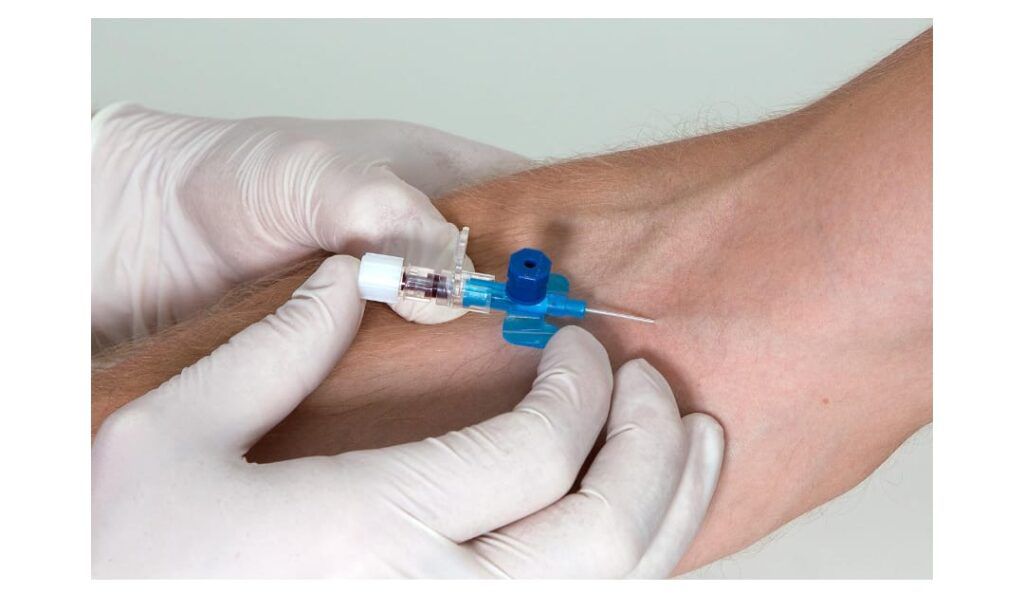
An IV drive is not a longer version of a single injection. It is an IV infusion at home: a clinician assesses the vein, inserts an IV cannula, connects a fluid or medication bag, sets the prescribed rate or duration, and watches for infiltration or leakage of medicine into surrounding tissue, called extravasation.
IV cannula care and extravasation monitoring continue throughout the treatment.
The clinician must check vascular access, drug compatibility, the patient’s stability, the home environment, and available support if a complication occurs. IV antibiotic therapy can also involve laboratory tests, renal-function monitoring, drug levels for selected medicines such as vancomycin, line checks, dressing care, pharmacy deliveries and dose reviews.
Before choosing a provider, ask these specific questions:
- Who inserts the IV cannula and monitors the infusion?
- What emergency equipment does the clinician carry?
- What happens if the cannula infiltrates or extravasation is suspected?
- Who arranges laboratory tests, pharmacy deliveries and clinician follow-up?
- Who reviews results and changes the dose?
Dhanraj Complete Healthcare Pvt. Ltd can be one provider you compare against those safety questions, rather than judging a service only by its booking hours. Redness, drainage, increasing pain, fever or chills around the catheter need prompt clinical assessment. A 24-hour booking claim does not replace IV-specific monitoring or follow-up.
Related products
Home injection 24hours services Home injection 24hours services patient all services available here 24x7 hours full services Convenience, less stress, and individualized care are just a few advantages of home... View product → |
 | Home injection services near by me Home injection services near by me 24x7 hours all injection services at home available here comfort, ease, and individualized attention. View product → |
What monitoring is needed after an injection, and when is home care unsafe?
Post-injection observation is not a fixed 15- or 30-minute rule. The medicine, dose, route and previous reaction history determine post-injection observation; follow the prescribing clinician’s instructions or the product label.
1. Before the visit, ask whether the service has a drug-specific escalation plan and emergency equipment. Keep your phone charged, emergency contacts available and the medicine packaging nearby.
2. Treat mild soreness, tenderness or a small bruise at the injection site as expected unless it worsens. Ask for clinical advice about spreading redness, increasing swelling, severe pain, fever or symptoms that do not improve.
3. Know when to call emergency services. Seek immediate help for breathing difficulty, facial or throat swelling, rapidly spreading hives, fainting, altered consciousness, chest pain, severe dehydration, uncontrolled bleeding, suspected overdose or signs of sepsis. These are possible anaphylaxis warning signs or other emergencies.
4. Do not use routine home care for an unstable patient or to delay emergency transport. An allergic reaction after injection can worsen quickly, and a home visit cannot replace emergency assessment.
5. After IV treatment, report catheter-site redness, drainage, swelling, worsening pain, fever or chills promptly. These symptoms need clinical assessment rather than watchful waiting.
6. Expect follow-up when the treatment requires it. A home visit may still be followed by blood tests, line checks, dose changes or clinician review. Safe convenience means knowing the next step before a reaction occurs.
Frequently asked questions
Which injections are suitable for administration at home?
Subcutaneous injections and some intramuscular injections may be given at home by a trained patient, caregiver, or clinician. Intravenous treatment requires a formal suitability assessment.
What should you prepare before the clinician arrives?
Keep the prescription, medicine packaging, dose instructions, allergies, medical records, and emergency contact details ready. Provide a clean, well-lit surface and clear access to the patient.
What happens during a home injection visit?
The clinician verifies the patient, medicine, dose, route, allergies, and prescription before giving the injection. They then dispose of sharps safely and observe the patient for an immediate reaction.
How is an IV drive different from a single injection?
An IV treatment delivers medicine or fluid through venous access over time, so it needs equipment, access-site checks, and closer monitoring than a single subcutaneous or intramuscular injection.
When is home injection care unsafe?
Home care is unsafe when the medicine needs continuous monitoring, the patient has a serious previous reaction, emergency support is unavailable, or IV access and treatment risks cannot be managed safely at home.
Related products
 | 24/7 home injection services 24x7 hours all types of injection available here Convenience, a lower risk of infection, and individualized care are just a few advantages of 24/7... View product → |
 | Injection On Call for IV Drives Injection On Call for IV Drives One of the most fundamental medical procedures is getting an injection. View product → |
 | Injectable medication delivery at home Injectable medication delivery at home 24x7 hours all types of ijnection medication services available here Injectable drug delivery to the patient's home has a number of advantages, chief... View product → |
 | Book injection at home in Gurugram Book injection at home in Gurugram 24x7 hours home book injection services available here Convenience, individualized treatment, and a lower risk of contracting other diseases are just... View product → |