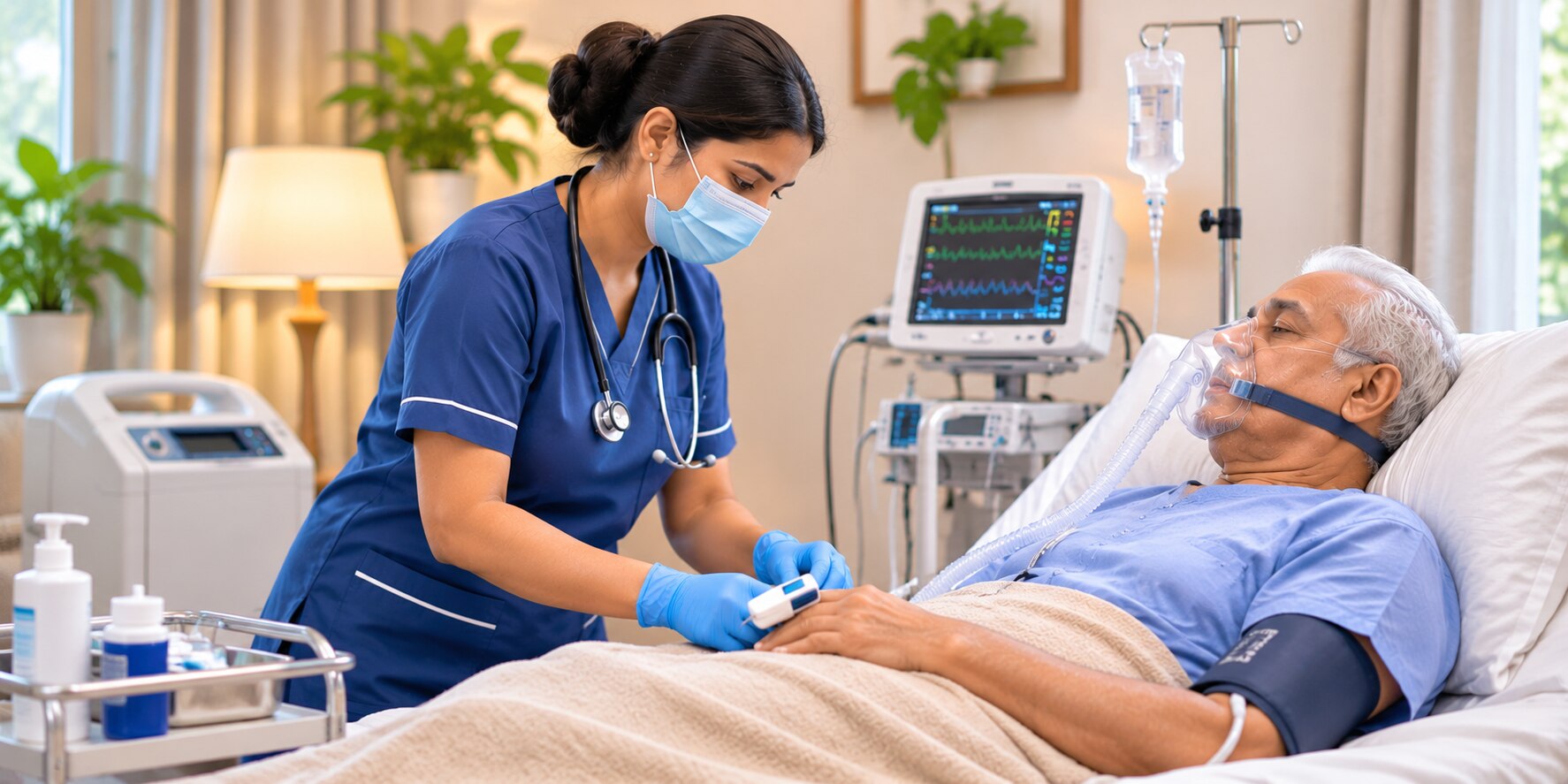
Complex patients at home need more than a nurse who can administer medicines: they need structured assessment, device-specific skills, reliable documentation and a defined route back to hospital. By the end, you will be able to judge whether home critical-care nursing is suitable, identify the equipment and caregiver skills required, and test whether an escalation plan is safe.
Key takeaways
- Choose home care only when the patient is stable enough for a defined escalation plan.
- Confirm equipment, emergency contacts, medication records and trained caregiver coverage before starting.
- Require nurses to record vital-sign trends, symptoms, interventions and escalation decisions.
- Move to hospital when deterioration exceeds the home team’s capability or available equipment.
What critical-care nursing at home actually involves
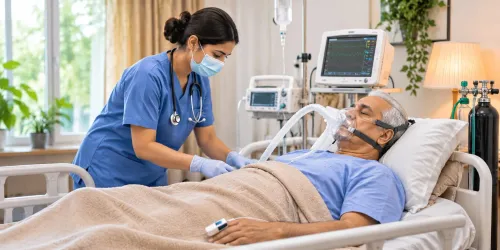
Critical-care nursing at home is skilled bedside management for a patient whose condition can change quickly, not simply having someone present. Home Nursing Care becomes critical-care nursing when the nurse performs ongoing assessment, interprets trends and acts within the prescribed plan.
- Airway patency, breathing effort, oxygen use and secretions
- Circulation, blood pressure, pulse and fluid balance
- Neurological status, alertness and new confusion
- Pain, agitation and sedation
- Nutrition, feeding tolerance and hydration
- Skin condition, pressure injury risk and wound changes
- Infection risk, including line or catheter findings
- Any departure from the patient’s usual baseline
| Role | What the person does | What it does not mean |
|---|---|---|
| Critical-care nurse | Provides skilled assessment, equipment checks, caregiver teaching and escalation during assigned care | Not merely sitting beside the patient |
| General home nurse | Performs routine nursing tasks within training, orders and competence | Not automatically authorised for critical-care procedures |
| Attendant | Helps with bathing, feeding, mobility, toileting and other daily living needs | Does not assess deterioration or change treatment |
| Visiting nurse | Makes scheduled assessments or performs ordered procedures | Does not provide continuous bedside observation |
The nurse trends observations, verifies that prescribed equipment is used correctly, reconciles every medicine with the intended dose, route and timing, teaches caregivers, updates doctors and coordinates specialist input.
A search for Nursing care at home Gurugram Near me does not establish that level of skill; ask who holds clinical responsibility and how quickly deterioration will be escalated.
Which patients are suitable for skilled care at home—and which are not
Home skilled care fits a patient whose treatment plan is settled, risks are understood, and caregivers can follow written instructions. Patient care services at home can support:
- Ventilator-dependent patients with prescribed settings and a defined backup plan
- Tracheostomy patients needing routine airway care and suctioning
- Patients using prescribed non-invasive ventilation
- People requiring frequent suctioning, complex wound care, feeding-tube care or central-line care
- Patients needing close observation after hospital discharge without rapidly changing symptoms
Home is the wrong setting for an active emergency:
| Home care may fit | Emergency care is needed |
|---|---|
| Stable breathing with an established support plan | Rapidly worsening breathlessness |
| A known rhythm and prescribed treatment | Unstable arrhythmia or shock |
| Routine wound, tube, line or suction care | Uncontrolled bleeding or cardiac arrest |
| Planned observation after discharge | New severe confusion |
| Care manageable with available equipment | Immediate imaging, laboratory tests, emergency procedures or specialist intervention |
Home care is not a hospital ICU moved indoors. Response time, diagnostic access and specialist availability remain limited, and a patient whose condition is changing quickly belongs in emergency care. A nurse can escalate deterioration, but cannot replace emergency transport, imaging or bedside specialists.
If you are comparing “ICU at Home Services in Gurugram Near Me,” judge suitability by clinical stability, equipment, trained caregivers and an emergency plan—not by the label. When those conditions are absent, call emergency services rather than waiting for a home-care visit.
The equipment, environment and caregiver skills a safe plan requires
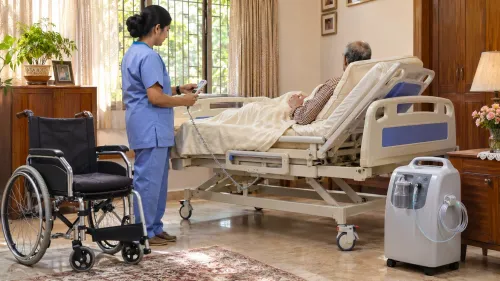
An ICU setup at home starts before discharge, not when equipment arrives. Confirm the oxygen source and backup cylinder, pulse oximeter, blood-pressure monitor, thermometer, suction machine, prescribed oxygen interfaces, infusion equipment when ordered, adjustable or safely positioned bed, power backup, PPE, sharps container and emergency supplies.
1. For tracheostomy care, place suction, oxygen, a manual resuscitation bag, an appropriately sized replacement tube, a smaller tube, obturator and ties at the bedside. Keep a written emergency algorithm visible; obstruction or accidental decannulation requires emergency services even after temporary ventilation is restored.
2. For ventilation, obtain the written settings, alarm responses, airway-clearance instructions, backup circuits, spare supplies and power-failure plan. Record battery duration, charging arrangements, oxygen interruption steps, the supplier’s after-hours number and the evacuation destination.
3. Make oxygen fire safety explicit: prohibit smoking, flames, sparks, heat sources and petroleum-based products near oxygen. Secure cylinders upright, protect concentrators from electrical overload and arrange delivery before the supply runs low.
4. Require each caregiver to demonstrate suctioning, alarm response, medicine administration, equipment changes, red-flag recognition and emergency activation. A nurse should observe the task, correct errors and document competency rather than accept verbal reassurance.
5. Name a backup caregiver and write an after-hours plan covering fatigue, illness, work absence, equipment failure and transport. Do not rely on memory, routine delivery schedules or one person’s availability; life-sustaining equipment needs a tested response pathway.
How nurses monitor, document and escalate deterioration
The treating clinician sets observation frequency according to the diagnosis, device and risk; there is no safe universal schedule. The nurse compares vital signs with the prescribed target and the patient’s usual baseline, recording respiratory rate, work of breathing, mental status, skin colour, pulse, secretion burden and oxygen saturation.
A normal pulse-oximeter reading does not rule out deterioration. Poor circulation, movement, nail products and abnormal haemoglobin can produce misleading readings, so the nurse also trends clinical appearance and breathing effort.
The record should include:
- Intake and output, medication administration, ventilator or oxygen settings, wound findings, line condition and feeding tolerance
- Tube position and prescribed feeding method, patient positioning, vomiting, coughing during feeds, abdominal distension and blocked tubing
- Handover notes stating what changed, what was done, the response and what the next nurse or caregiver must watch
A written escalation plan names who may change treatment, who holds decision authority, when to call the treating doctor, when to activate emergency transport and how quickly backup arrives. It prevents a caregiver from relying on memory during a crisis.
Call for action—not informal observation—for fever, rigors during an infusion, line redness or drainage, catheter breakage, tube displacement, vomiting, abdominal distension, new confusion or worsening work of breathing. If you search for Nursing services visit at home near me, ask to see this monitoring and escalation process before care begins.
Home or hospital: how to make the care decision and assess a provider
Home is appropriate only when the patient is clinically stable, the home is safe, and a hospital-transfer plan is ready. It is not an ICU reproduced indoors.
| Option | Strengths | Limits |
|---|---|---|
| Home | Continuity, privacy, familiar surroundings, controlled environment, lower exposure to hospital infections | Slower emergency response; no on-site imaging, laboratory access, or full specialist team; equipment capacity is finite |
| Hospital | Immediate imaging, laboratory testing, procedures, specialists, monitoring, and emergency transport | Greater exposure to healthcare-associated infection, less privacy, and more handovers |
Home suits selected Post-surgery nursing care at home and technology-dependent patients when continuity outweighs these limits. Families must separately arrange overnight supervision, respite, emergency transport, power-loss response, oxygen-interruption response, suction-failure response, and cover for caregiver fatigue.
Before choosing a provider, request these items:
- Confirm the nurse’s critical-care experience and authority for each required procedure; “Nursing services visit at home near me” does not prove critical-care competence.
- Request the written care plan, escalation algorithm, medication-reconciliation record, and handover format.
- Verify equipment backup arrangements, backup-power duration, spare oxygen and suction supplies, and the supplier’s after-hours number.
- Require caregiver competency sign-off for alarms, suction, medicines, tube emergencies, and emergency activation.
Dhanraj Complete Healthcare Pvt. Ltd can be one Gurugram comparison point, but judge every provider by clinical suitability, staffing, equipment redundancy, and emergency coordination—not a promise that home matches hospital ICU capacity.
Frequently asked questions
What does critical-care nursing at home involve?
It involves skilled bedside care, ongoing assessment, trend interpretation, prescribed interventions, documentation and escalation when the patient deteriorates.
Which patients are suitable for critical-care nursing at home?
Patients need a defined clinical plan, appropriate equipment, trained caregivers, reliable nursing coverage and a clear route to hospital care. Patients needing interventions or monitoring unavailable at home are not suitable.
What equipment and preparation does home critical care require?
The plan may require prescribed monitoring devices, oxygen or other clinical equipment, medication and treatment records, infection-control supplies, emergency contacts and trained caregiver support.
When should home care be replaced by hospital care?
Choose hospital care when the patient’s condition is unstable, deterioration cannot be managed under the home plan, or required monitoring, treatment, staffing or emergency support is unavailable.
Keywords