


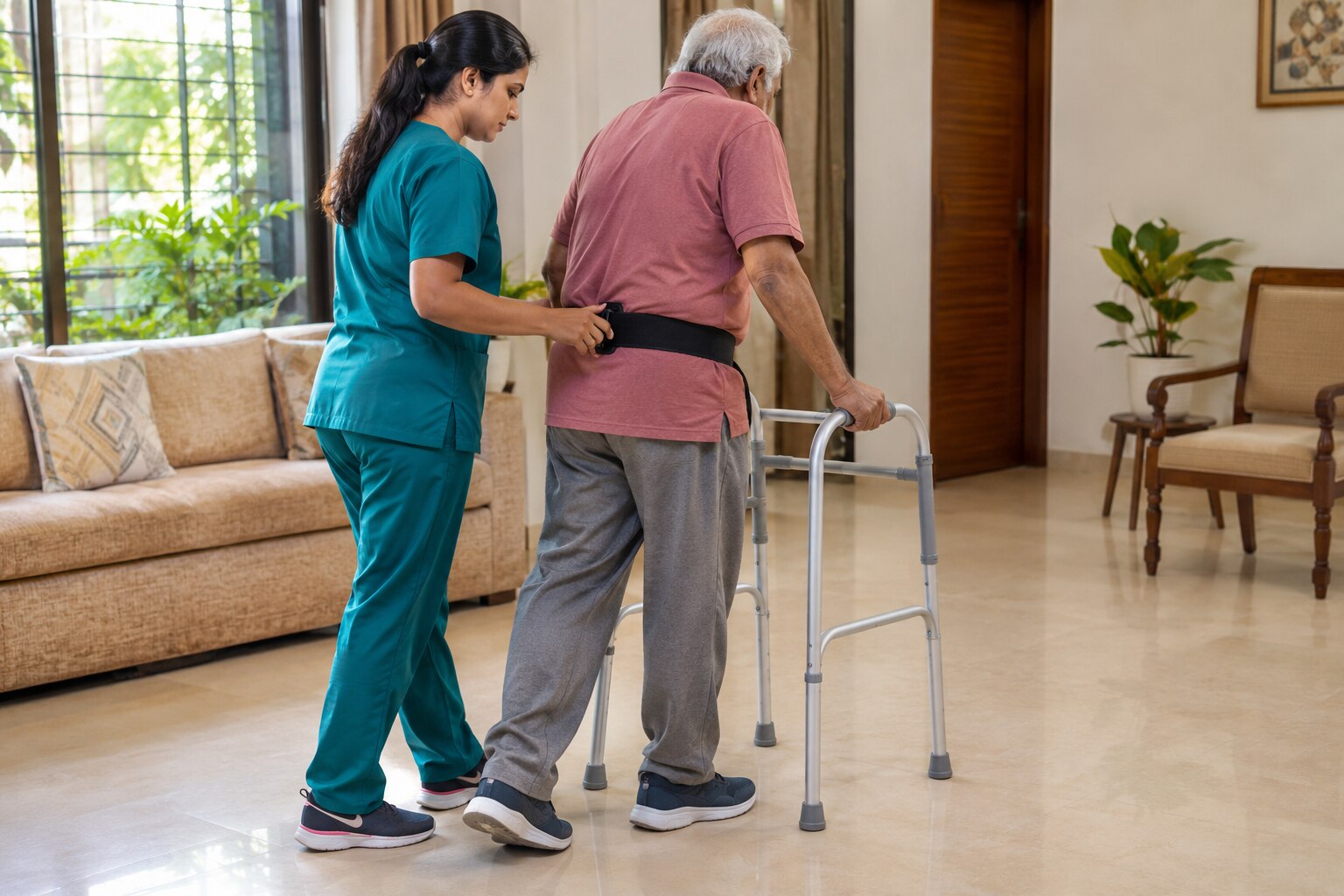
Pain, weakness, swelling, restricted movement, and fear of falling can make ordinary tasks difficult after an operation or injury. You will learn how a home programme establishes a functional baseline, progresses from basic transfers to walking and stairs, and uses measurable goals while respecting surgical precautions and warning signs.
Key takeaways
- Follow the surgeon’s weight-bearing and movement restrictions before increasing activity.
- Expect the first visit to assess pain, swelling, wounds, strength, balance, and home hazards.
- Increase exercise repetitions or walking distance only when symptoms and movement remain controlled.
- Seek medical advice for worsening pain, spreading redness, wound drainage, chest pain, or breathlessness.
What happens during the first home physiotherapy visit?
The first home physiotherapy visit identifies what the patient cannot do safely and why. The physiotherapist reviews the operation or injury, medical conditions, medicines, pain, swelling, wound status, weight-bearing order, and movement precautions. The surgeon’s restrictions take priority; walking farther or putting weight on a limb before clearance can disrupt healing.
The assessment usually includes:
- Bed mobility, rolling, sitting balance, sit-to-stand, transfers, and walking with the prescribed aid
- A mobility assessment after surgery, including gait quality, walking distance, balance, confidence, and breathlessness
- Range of motion at the affected joints, compared with the other side when appropriate
- Muscle strength testing and observation of control during standing, stepping, and transfers
- The patient’s ability to manage essential daily tasks, such as using the toilet, bathing, dressing, and reaching the bed or kitchen
The therapist then walks through the actual home route rather than judging mobility only on a clinic floor. They check narrow walkways, stairs, loose rugs, lighting, bed height, bathroom transfers, footwear, door thresholds, and the surfaces used for everyday walking.
These barriers explain why a patient may manage a few clinic steps but struggle at home.
The visit ends with a documented baseline and a practical plan: which movements to practise, how to use the walking aid, what assistance is needed, and which warning signs require medical review.
How does rehabilitation progress after different injuries and operations?
Rehabilitation advances from bed mobility to daily activities by matching each task to healing restrictions, muscle control, balance, and symptoms—not to a calendar alone. The surgeon’s weight-bearing and movement orders take priority; loading a healing repair too early can cause damage, while unnecessary restriction causes weakness.
- After hip replacement rehabilitation, the therapist practises rolling, sitting, transfers, standing, walking with a frame or crutches, and safe turning. Hip precautions, leg strength, pain, and the height of the bed or toilet determine the next step.
- Knee replacement physiotherapy adds knee bending and straightening, quadriceps control, walking quality, stairs, and repeated sit-to-stand practice. Progress means needing less support and controlling the knee, not forcing a painful range.
- Fracture fixation recovery follows the permitted weight-bearing level while rebuilding transfers, balance, walking confidence, strength, and activities such as washing and dressing.
- Ligament reconstruction rehabilitation protects the repair while restoring joint control, gait, balance, and task-specific strength. The operation and graft protocol decide when resistance or full loading begins.
- After stroke, therapy addresses the weaker side, trunk control, transfers, standing balance, walking, and safe use of the arm during everyday tasks.
- After spinal surgery, the therapist teaches log-rolling, posture, transfers, walking, and stair technique while respecting lifting, bending, and twisting restrictions.
The therapist rehearses real obstacles—stairs, narrow passages, bathroom transfers, lighting, and outdoor surfaces—then increases distance, speed, independence, and task complexity as control improves. Increasing pain, swelling, wound problems, new weakness, or loss of function requires medical review before progression.
Which exercises improve mobility, and how should you dose them?
Use only postoperative home exercises cleared for your operation, injury, and weight-bearing restrictions. A prescription should name the movement, aid or support, exercise repetitions and sets, walking time, rest period, and the rule for progressing or reducing the dose.
| Exercise | Starting dose | Progression |
|---|---|---|
| Ankle pumps | 10–20 repetitions, 1–2 sets, several times daily | Add repetitions before adding resistance |
| Heel slides | 5–10 repetitions, 1–2 sets, once or twice daily | Increase range only without forcing the joint |
| Sit-to-stand | 3–5 repetitions, 1–2 sets, once daily | Add repetitions when control remains steady |
| Walking exercise after surgery | 5–10 minutes with the prescribed aid | Add 1–2 minutes after comfortable sessions |
Rest 30–60 seconds between sets, or longer if your breathing, balance, or movement quality worsens. Break walking into shorter bouts when one continuous walk increases pain or causes limping.
Exercise-related pain and swelling should settle after rest and return to your previous baseline by the next day. If swelling increases, pain becomes sharper, or movement deteriorates, reduce repetitions by half, shorten walking, elevate the limb, and return temporarily to an easier exercise.
Do not increase repetitions, sets, resistance, and walking time together; change one measure after at least two comfortable sessions and follow the therapist’s planned limit. Stop and contact the clinical team if wound drainage, calf swelling, new weakness, or severe pain appears.
How are progress, visit frequency, and home safety measured?
Improvement is real when daily tasks become safer, easier, or less dependent on another person—not simply when pain falls or joint range increases. The therapist records a baseline and repeats the same test under similar conditions, so a faster transfer or longer walk reflects change rather than guesswork.
Useful physiotherapy progress measures include:
- Timed sit-to-stand, including the number of repetitions and use of arm support
- Walking distance after surgery, walking speed, gait quality, and the walking aid required
- Bed-to-chair and toilet transfers, recorded as independent, supervised, or assisted
- Stair performance, standing balance, and the number of rests needed
- The amount of help required for dressing, bathing, meal preparation, and other essential tasks
Visit frequency should match the risk and the goal. A therapist may review more often when weakness, complex precautions, poor balance, or limited family support makes unsupervised practice unsafe; visits can reduce as you perform the programme correctly and manage essential tasks independently.
Review the plan after a clear milestone, a plateau over several sessions, increased swelling or pain, a change in weight-bearing instructions, or difficulty following the prescribed dose.
Each visit should also check fall prevention at home: clear walking routes, adequate lighting, stable footwear, safe bathroom transfers, bed and chair height, and correct use of rails or walking aids.
Stop or pause an exercise when it causes sharp pain, wound concerns, new loss of function, dizziness, or repeated near-falls, and seek clinical advice before restarting.
When is home physiotherapy suitable, and when is medical escalation needed?
Begin or continue home physiotherapy when your condition is medically stable, the operation’s restrictions are clear, and you can follow a specific programme with the required support. The plan should state each exercise, repetitions or walking time, permitted aid, stopping limits, and how to progress.
Home physiotherapy safety depends on matching the dose to your procedure, strength, wound status, and balance. Obtain surgeon clearance for physiotherapy after surgery if weight-bearing, range of motion, brace use, lifting, or spinal precautions are unclear.
Ask the surgeon before starting if pain or swelling is worsening, the wound is opening or draining, fever develops, or you suddenly cannot bear weight.
Seek urgent hospital assessment rather than waiting for a home visit if you have:
- New calf or thigh swelling, warmth, tenderness, or one-sided pain: these are deep vein thrombosis warning signs.
- Sudden breathlessness, chest pain, coughing blood, fainting, or an unexplained rapid heartbeat: these can indicate a pulmonary embolism.
- Heavy bleeding, severe uncontrolled pain, new confusion, or rapidly worsening weakness.
These postoperative emergency symptoms need immediate medical attention, not an exercise adjustment. If you are stable but need supervised practice at home, contact a provider such as Dhanraj Complete Healthcare Pvt. Ltd and share the discharge summary, surgeon’s restrictions, medication list, walking aid, and any recent change in symptoms before the first visit.
Related products
 | Home Physiotherapist Doctor Our physiotherapist makes house calls to treat patients in the convenience of their own homes. View product → |
 | Home Physiotherapy services Near by me Home Physiotherapy services Near by me 24x7 hours full services for all patients available here On Emergency services for patients calling number : 9818401536 Numerous advantages make home... View product → |
Frequently asked questions
What happens during the first home physiotherapy visit?
The physiotherapist reviews your injury or operation, medicines, pain, swelling, wound status, weight-bearing order, movement precautions, strength, balance, walking, and home safety.
How does rehabilitation progress after different injuries and operations?
Progress follows the tissue involved, surgical restrictions, healing stage, pain response, and functional goals. The physiotherapist advances movement, strength, balance, and walking within the surgeon’s instructions.
Which exercises improve mobility, and how should you dose them?
Exercises may include prescribed joint movement, muscle activation, strengthening, balance, transfers, and walking practice. Use the repetitions, sets, walking distance, and rest periods prescribed for your condition, and stop if symptoms worsen.
How are progress, visit frequency, and home safety measured?
Progress is measured through walking distance, transfers, range of motion, strength, balance, pain, swelling, and daily activities. Visit frequency changes as you become safer and more independent, while the therapist checks obstacles, lighting, footwear, stairs, and support surfaces.
When is home physiotherapy suitable, and when is medical escalation needed?
Home physiotherapy suits patients who are medically stable but cannot travel safely or need supervised rehabilitation at home. Contact the surgical or medical team for worsening pain, swelling, redness, wound drainage, fever, or loss of function; seek emergency help for chest pain, severe breathlessness, or sudden weakness.