


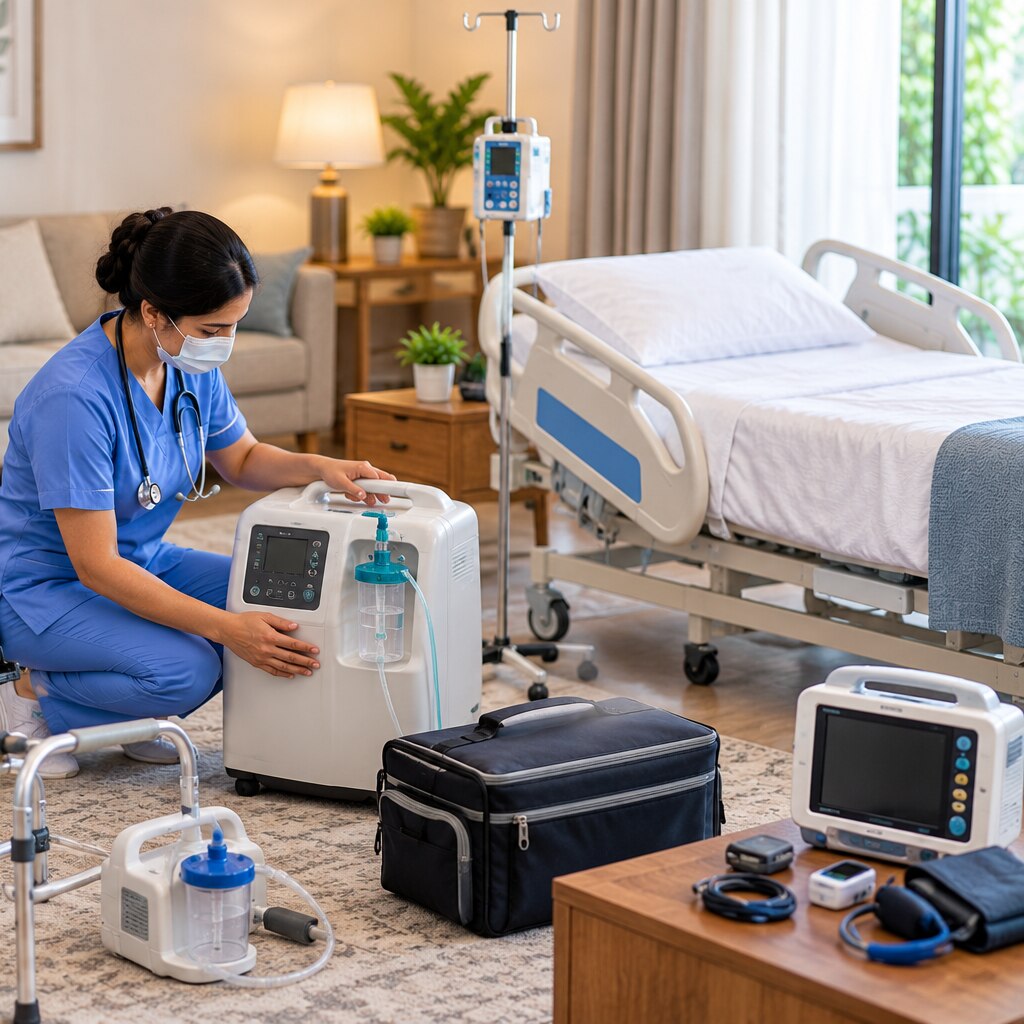
The right home equipment depends on more than the diagnosis: weight-bearing ability, cognition, caregiver capacity, room layout, power supply and recovery time all change the safe choice. You will be able to identify the core devices, separate prescription equipment from family-selected aids, and create a practical plan for use, cleaning, emergencies and transport.
Key takeaways
- Measure doorways, corridors, bathroom access, outlets, floor space and bed height first.
- Choose mobility equipment after checking balance, transfer ability, cognition and caregiver strength.
- Use oxygen, suction and monitoring devices only under clinical direction and training.
- Confirm every device fits the room, supports the patient’s weight and has a safe-use plan.
Match the equipment to the patient and the home
Start with a patient assessment, not a diagnosis. Record the patient’s weight, height, mobility, balance, cognition, breathing needs, skin risk, transfer ability, caregiver strength and expected recovery period. Then measure doorways, corridors, bathroom access, floor space, electrical outlets and bed height.
| Equipment choice | Check before choosing | Mismatch risk |
|---|---|---|
| Hospital bed or ordinary bed | Need for repositioning, transfer height, pressure relief, rails and available floor space | Falls, trapped limbs or unsafe transfers |
| Walker or wheelchair decision | Weight-bearing order, balance, arm strength, doorway width and caregiver assistance | A walker can cause a fall; a wheelchair can encourage unsafe transfers |
| Oxygen, suction or monitor | Prescription, settings, interface, power supply, alarms and trained caregiver | Incorrect treatment, missed deterioration or equipment failure |
| Commode or transfer aid | Toilet distance, patient weight, transfer method and cleaning access | Falls, tipping or delayed toileting |
Use a home medical equipment checklist to match each item to a specific task: walking, bathing, toileting, repositioning or breathing support. Check the manufacturer’s weight limit and the patient’s ability to operate controls; an advertised maximum does not make a device suitable.
Ask the discharging clinician to approve oxygen, suction, infusion pumps and monitoring equipment, including settings and alarm responses. A scheduled wheelchair or stretcher transport suits a stable patient; rapidly worsening breathing, circulation, consciousness or bleeding requires emergency medical services, not a routine transport appointment.
Build a mobility and daily-care equipment checklist
Start with the tasks the patient cannot complete safely: standing, turning, moving from bed to chair, reaching the toilet and staying off one pressure point. Equipment must match weight limits, balance, cognition, arm strength and the caregiver’s ability to assist.
- Hospital bed: use adjustable height and backrest positions to support care and safer transfers.
- Pressure-relief mattress: choose it for a patient who spends long periods in bed or cannot reposition independently; it does not replace scheduled skin checks and repositioning.
- Wheelchair: check seat width, weight capacity, brakes, footrests and doorway clearance before delivery.
- Walker: walker height adjustment is important for safe use; handles should align near the wrist crease when the user stands upright with relaxed shoulders.
- Transfer aids: consider a transfer board, gait belt, pivot disc or mechanical lift only when the patient’s transfer ability and caregiver training suit that device.
- Commode chair: place it close to the bed, lock its wheels and confirm that its seat height allows controlled sitting and standing.
| Device | Main job | Check before use |
|---|---|---|
| Hospital bed | Positioning and transfers | Bed height, rail use and electrical access |
| Wheelchair | Seated movement | Brakes, footrests, cushion and route width |
| Walker | Supported walking | Correct height, rubber tips and clear path |
| Commode chair | Bedside toileting | Stable placement, bucket cleaning and transfer space |
| Pressure-relief mattress | Reduce sustained pressure | Correct size, inflation or settings and skin-monitoring plan |
A clinician or trained therapist should approve mechanical lifts, complex transfer systems and pressure-management equipment when weakness, paralysis, confusion or falls make a basic aid unsafe.
Choose respiratory and monitoring equipment under clinical direction
Do not choose breathing equipment from a diagnosis or an advertised maximum. Match the device to the clinician’s prescription, target readings, interface, power supply, and the caregiver’s ability to respond.
| Device | Clinical direction required | Home requirement |
|---|---|---|
| Oxygen concentrator | Prescribed flow rate and hours of use | Electrical backup and a written response plan for power failure |
| Oxygen cylinder | Prescribed cylinder size and flow rate | Oxygen cylinder safety: secure it upright, keep it away from flames and heat, and never use it as a substitute for a failed ventilator |
| Suction machine | Prescribed pressure, catheter type, and suction frequency | A trained caregiver who can clear secretions without injuring the airway |
| Nebuliser | Prescribed medicine, dose, and treatment schedule | Demonstrated nebuliser use at home, including cleaning and recognising worsening breathlessness |
| Home ventilator | Programmed pressure or volume, alarms, and backup settings | Trained caregiver, backup power, backup ventilation, and an individual emergency plan |
| Patient monitor | Defined alarm limits and response instructions | Someone who can distinguish a technical alarm from clinical deterioration |
| Pulse oximeter | Target range and escalation threshold from the clinician | Correct probe placement and an understanding of pulse oximeter limitations |
A ventilator supports or replaces breathing; an oxygen concentrator only changes the oxygen concentration of inhaled gas. A patient with rapidly worsening breathing, consciousness, or circulation needs emergency medical help, not a routine equipment visit. Do not silence alarms or alter settings without clinical instruction.
Prevent the common mistakes that cause home-care injuries
Most home-care injuries begin with a rushed transfer, a blocked alarm, or equipment placed where it cannot work. Use the patient’s prescribed settings and weight limits, not the device’s advertised maximum.
- For a safe patient transfer, lock the bed and wheelchair, raise the bed to working height, clear tubing, and use the prescribed transfer aid. Never pull a patient by the arms.
- Check wheelchair brakes and footrests before every move. Lock both brakes, swing footrests away during transfer, then return them before travel.
- Practise bed rail safety: keep rails positioned as instructed, leave an exit route, and never use rails as restraints unless the care plan specifically directs it.
- Keep walkers level and close, and place commodes where the patient can reach them without crossing loose rugs, cords, or oxygen tubing.
- Follow the prescribed suction settings. Too much suction can injure tissue; too little can leave secretions blocking the airway.
- Treat alarm response as a written procedure: check the patient first, then the tubing, power supply, sensor placement, and displayed code. Do not silence an alarm without finding its cause.
- Follow the item-specific medical equipment cleaning schedule. Wiping a machine’s exterior does not disinfect internal tubing, masks, suction parts, nebuliser cups, or fluid-contact surfaces.
Apply oxygen fire safety every time: prohibit smoking, candles, gas flames, and sparks near oxygen, and keep cylinders upright and secured. If breathing, consciousness, circulation, or bleeding worsens quickly, call the local emergency service rather than waiting for scheduled transport or equipment support.
Turn an equipment list into a workable home-service plan
Before you sign, ask the provider to convert the discharge prescription into a written home plan. It should name each device, settings, weight limit, interface, delivery date, installation steps, consumables, caregiver training and the person to call when an alarm or failure occurs.
Confirm these points:
- Whether you should rent or buy medical equipment, including the total cost, deposit, minimum term, replacement rules and collection date.
- What the equipment maintenance agreement covers: preventive servicing, breakdown response, loaner equipment, cleaning and after-hours support.
- Whether the home has enough sockets and circuit capacity. A concentrator needs electricity, so request backup power for oxygen, such as approved cylinders, and instructions for a power cut.
- Whether a home ICU setup includes suction, monitoring, oxygen, emergency supplies, alarm training, caregiver competency checks and a backup ventilation plan. An oxygen cylinder cannot replace a failed ventilator.
- For transport, confirm stretcher or wheelchair access, lifting limits and clinical capability. Non-emergency medical transport suits a stable patient; rapidly worsening breathing, circulation, consciousness or bleeding requires an emergency ambulance.
- For a complex discharge in Gurugram, ask Dhanraj Complete Healthcare Pvt. Ltd to document these responsibilities before delivery rather than leaving them to verbal instructions.
| Option | Confirm before choosing | Main risk if unclear |
|---|---|---|
| Rental | Term, servicing, return conditions | Paying after recovery |
| Purchase | Warranty, parts, disposal | Owning unsupported equipment |
| Setup | Room layout, power, training | Unsafe alarms or transfers |
| Transport | Patient stability and vehicle equipment | Delaying emergency care |
Frequently asked questions
What should you assess before choosing home medical equipment?
Record the patient’s weight, height, mobility, balance, cognition, breathing needs, skin risk, transfer ability, caregiver strength and expected recovery period. Measure doorways, corridors, bathroom access, floor space, electrical outlets and bed height.
How do you build a home mobility and daily-care equipment checklist?
Match each task to the patient’s abilities and the home’s layout. Check equipment for weight capacity, dimensions, transfer support, bathroom access, caregiver handling and space for safe movement.
When should you use respiratory or patient-monitoring equipment at home?
Use oxygen, suction, pulse oximeters and other respiratory or monitoring devices only when a clinician has identified the need, set instructions and trained the patient or caregiver.
What causes common home-care equipment injuries?
Falls and transfer injuries result from poor equipment fit, blocked pathways, incorrect bed or chair height, unsafe lifting, missing brakes and untrained caregivers. Inspect the setup and practise each transfer before routine use.