


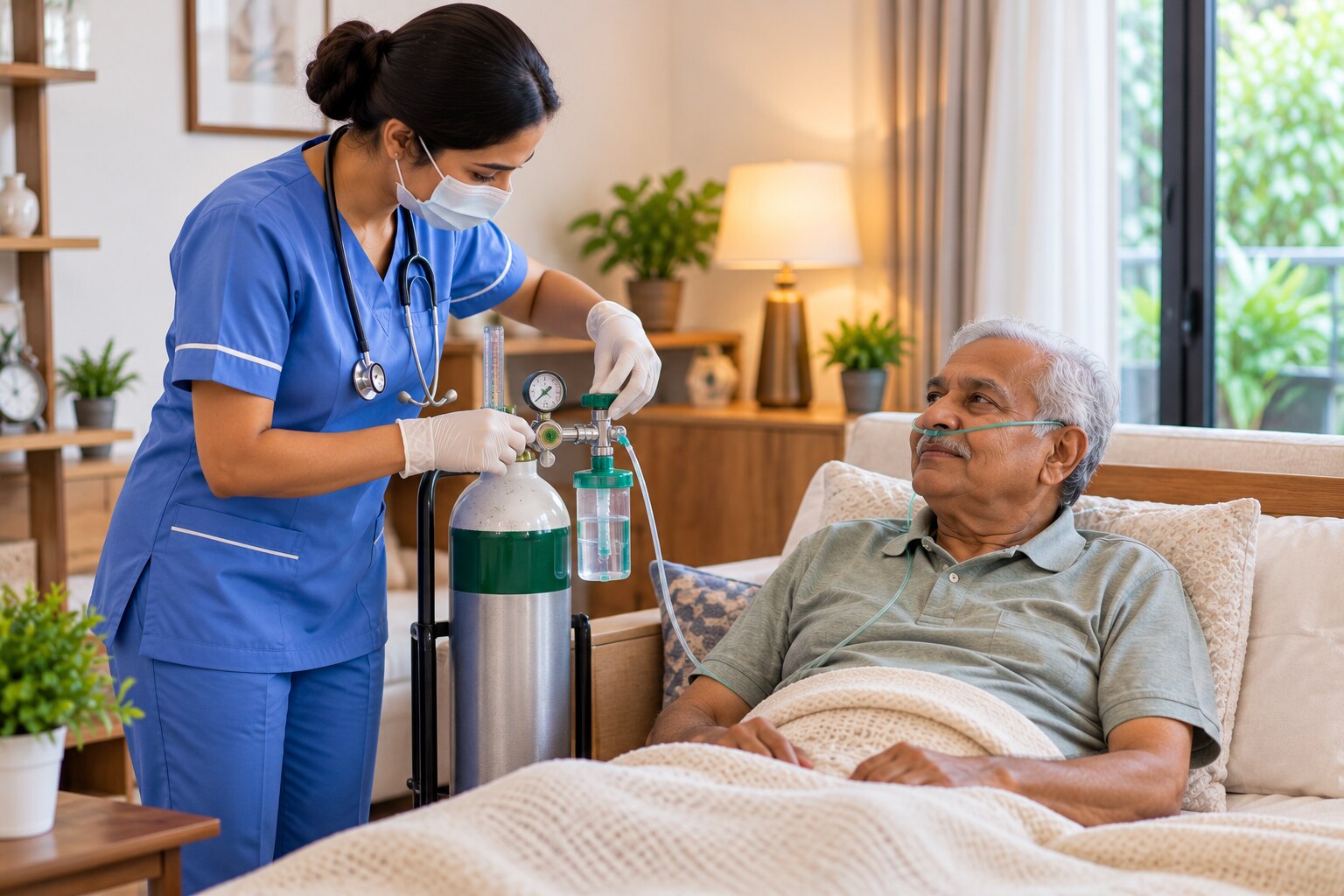
Before arranging delivery, confirm that oxygen is prescribed for the patient and record the exact flow rate, delivery method, and hours of use. You will also need to match the cylinder to the patient’s runtime, compare it with a concentrator, inspect the equipment, and prepare a safe refill and emergency plan.
Key takeaways
- Confirm flow rate, target saturation, hours, and sleep or activity needs.
- Calculate cylinder runtime from capacity, pressure, and prescribed flow rate.
- Inspect the seal, valve, regulator, label, and leak condition at delivery.
- Keep oxygen away from flames and arrange refills before the cylinder runs out.
Confirm the prescription before arranging delivery
Home oxygen is appropriate only after a clinician issues a home oxygen prescription based on the patient’s condition, oxygen measurements, and treatment goals. The prescription must state the target oxygen saturation, oxygen flow rate litres per minute, hours of use, and whether oxygen is needed during sleep, activity, travel, or continuously.
Before arranging delivery, give the supplier these exact instructions:
- Provide the prescribed flow setting and confirm whether it is continuous flow or pulse-dose delivery. A standard litres-per-minute regulator and a conserving device are not interchangeable.
- Specify the delivery interface: nasal cannula or oxygen mask. Do not accept a substitute device without the prescriber’s approval.
- State the required duration of use and ask the supplier to match the cylinder, regulator, and backup supply to that schedule.
- Ask for the cylinder’s usable gas volume, current pressure, residual reserve, and an explanation of how to estimate minutes remaining. Approximate minutes remaining equals usable gas volume in litres divided by prescribed flow in litres per minute.
Do not start, stop, or increase oxygen because a pulse oximeter shows a low or unreliable reading; contact the prescribing clinician for advice. Severe worsening breathlessness, blue or gray lips, confusion, fainting, or chest pain requires emergency medical assessment, not a higher flow setting or a delivery request.
Match cylinder capacity to runtime and daily use
Estimate runtime by dividing usable gas volume in litres by the prescribed continuous flow in litres per minute. A 10-litre cylinder filled to 150 bar contains about 1,500 litres before accounting for residual reserve, regulator accuracy, and the point at which the supplier requires replacement.
At 2 L/min, the theoretical duration is 750 minutes, or 12.5 hours—not a guaranteed bedside runtime.
An oxygen cylinder duration calculator is useful only when you enter the cylinder’s actual capacity, pressure gauge reading, prescribed flow, and regulator type. Continuous flow oxygen uses gas throughout inhalation and exhalation; a pulse-dose device releases a measured bolus only after detecting a breath.
Its displayed setting is not equivalent to the same number in L/min, especially during sleep, mouth breathing, shallow breathing, or exertion.
Record these details before choosing a cylinder:
- Oxygen cylinder capacity and full pressure
- Prescribed flow in L/min and hours of use
- Continuous-flow or pulse-dose delivery
- Reserve level at which replacement must be ordered
Oxygen concentrator versus cylinder depends on how reliably electricity and refills are available.
| Option | Strength | Limitation |
|---|---|---|
| Cylinder | Works without household electricity and suits transport | Requires refills and has finite runtime |
| Concentrator | Produces oxygen continuously for regular daily use | Needs electricity and a backup plan for outages |
A concentrator is often more practical for many hours of daily use, while cylinders remain important for travel and power-cut backup. Do not increase flow to stretch runtime or respond to severe breathlessness, blue or gray lips, confusion, fainting, or chest pain; seek emergency medical assessment.
Compare suppliers and inspect the cylinder at delivery
Ask every supplier the same oxygen cylinder rental questions: Is the cylinder filled for medical oxygen, what is its stated capacity and pressure, and how will you calculate usable minutes at the prescribed flow?
Ask for the oxygen purity certificate, refill price, delivery time, emergency replacement process, and charges for the regulator, deposit, transport, and pickup.
Rental or purchase changes your obligations:
| Option | What to compare | When it applies |
|---|---|---|
| Rental | Deposit, refill and replacement terms, maintenance responsibility, and return conditions | Best when oxygen use may be temporary or capacity needs could change |
| Purchase | Up-front cost, approved refilling arrangements, inspection records, and future servicing | Consider when long-term use is confirmed and you can manage testing and refills |
| Either | Written confirmation of the prescription, flow-control device, and delivery address | Reject a supplier that substitutes a device because the requested model is unavailable |
Dhanraj Complete Healthcare Pvt. Ltd can be included in your comparison, but ask for these details in writing rather than relying on a service label.
Before accepting delivery, match the patient’s name, cylinder serial number, capacity, pressure gauge, valve, and cylinder test date with the delivery record. Reject cylinders with dents, deep rust, oil or grease, a damaged valve, missing markings, broken seals, or an unreadable gauge.
Confirm the supplier’s maintenance record and oxygen regulator compatibility; a pulse-dose device is not a continuous-flow setting. Do not repair, refill, or pressure-test the cylinder yourself.
Related products
 | Oxygen cylinder services at home Oxygen cylinder services at home For those with respiratory disorders, home oxygen cylinders provide a number of advantages, such as a better supply of oxygen, portability, and... View product → |
 | oxygen cylinder Rent & Sell Online 24/7 oxygen cylinder Rent & Sell Online 24/7 The most popular items oxygen cylinder Rent & Sell Online 24/7 Welcome To our services company 'Dhanraj Complete Healthcare Private Limited' in... View product → |
Connect and use the equipment without creating a hazard
To learn how to use an oxygen cylinder at home, keep it upright and secure it with a stand, chain, or approved holder before opening the valve. Check the label, pressure gauge, tubing, nasal cannula or mask, and oxygen cylinder regulator for damage.
Do not force a connection or use a regulator intended for another gas.
- Wash and dry your hands; keep oil, grease, petroleum jelly, and alcohol-based products away from the valve and fittings.
- Attach the regulator firmly, open the cylinder valve slowly, and set only the prescribed flow in litres per minute.
- Perform an oxygen leak test soapy water on the regulator and hose connections. Bubbles indicate a leak: close the valve, move away from ignition sources, and call the supplier.
- Route tubing along walls or under a proper cover, never across a walkway. Replace damaged, kinked, or crushed tubing.
- Close the valve when the cylinder is not in use, unless the equipment instructions say otherwise. Do not change the flow or delivery method without clinical advice.
Oxygen fire safety means no smoking, candles, gas stoves, incense, flames, or spark-producing appliances near the cylinder. Keep smoke alarms working and leave at least 2 metres between oxygen equipment and flames or heat sources.
Store spare cylinders upright, capped where the design requires a valve-protection cap, dry, ventilated, and away from exits. For transport, secure the cylinder so it cannot roll or fall, keep it upright, ventilate the vehicle, and never leave it in a hot parked car.
Plan refills, power cuts, and equipment failure before they happen
Set a replacement trigger before the cylinder is nearly empty. Your oxygen cylinder refill plan should identify the primary source, the required reserve, the supplier’s delivery time, and the oxygen equipment emergency contact for refills, regulator faults, leaks, or damaged cylinders.
1. Check the oxygen cylinder pressure gauge at the agreed intervals and record the reading. Ask the supplier how much usable oxygen remains at your prescribed flow; gauge pressure alone cannot show hours left without the cylinder size, regulator, and flow setting.
2. Arrange the next cylinder before the supplier’s stated delivery window becomes urgent. Estimate minutes remaining by dividing usable gas volume in litres by prescribed continuous flow in litres per minute, then allow for residual reserve and delivery delays.
3. If a concentrator is the primary source, keep a charged or full cylinder ready as oxygen backup during power outage. Confirm how long it will run, which flow setting applies, and who can deliver another cylinder if the outage continues.
4. Keep the written contact list beside the equipment, with separate numbers for delivery, refills, technical faults, and emergency medical help. Test the backup plan with every household member.
Keep smoke alarms working, route tubing away from walkways, and inspect connections for damage. If oxygen use coincides with severe breathlessness, blue or gray lips, new confusion, fainting, or chest pain, seek emergency medical assessment; do not simply increase flow or wait for delivery.
Frequently asked questions
What should a home oxygen prescription include?
It should state the target oxygen saturation, flow rate in litres per minute, hours of use, and whether oxygen is needed during sleep, activity, travel, or continuously.
How do you choose the right oxygen cylinder capacity?
Match the cylinder’s usable oxygen and expected runtime to the patient’s prescribed flow rate and daily hours of use. Choose enough capacity to cover delivery delays and planned use.
What should you inspect when an oxygen cylinder arrives?
Check the cylinder label, batch or identification details, valve, pressure gauge, regulator, tubing, nasal cannula, seal, and visible damage. Do not accept equipment with leaks, a broken seal, or an unreadable pressure gauge.
How can you use an oxygen cylinder safely at home?
Keep the cylinder upright and secured, use the prescribed flow rate, keep it away from flames, smoking, heat, oils, and grease, and avoid changing the setting without clinical instructions.
What should you do before an oxygen cylinder runs out or power fails?
Track daily consumption, schedule refills before the expected empty date, keep the supplier’s emergency number available, and agree on a backup plan for power-dependent equipment and delivery delays.