


A safe home plan begins with more than a diagnosis: it must record the stroke timeline, current neurological deficits, swallowing status, mobility, cognition, and medical stability. By the end, you will have a practical framework for emergency decisions, daily responsibilities, rehabilitation, medication management, nutrition, equipment, and caregiver readiness.
Key takeaways
- Call emergency services for new weakness, speech loss, severe headache, or reduced alertness.
- Record every medicine, dose, timing, and blood-pressure reading in one log.
- Request a swallowing assessment before giving food, drink, or oral medicines after a stroke.
- Test caregiver skills and equipment before leaving the patient alone at home.
Start With a Stroke-Specific Assessment and an Emergency Rule
A safe stroke home care assessment starts with the diagnosis, stroke date, affected side, mobility level, and current medical stability. Assess cognition, communication, neglect, visual-field loss, mood, fatigue, executive function, swallowing, continence, vision, and the patient’s ability to follow emergency instructions. Limb strength alone cannot prove that home care is safe.
- Confirm the person can transfer, walk or use prescribed equipment safely, and manage essential tasks with trained help. Test medication handling, cooking awareness, toileting, and supervision needs.
- Review the discharge plan with the doctor, nurse, physiotherapist, and speech-language therapist. Verify diet texture, swallowing precautions, communication methods, exercises, equipment, and who responds to deterioration.
- Write down the last known well time: the last time the person was definitely without new symptoms. This helps emergency clinicians assess time-dependent treatments, including intravenous alteplase within 4.5 hours for eligible patients and thrombectomy for selected patients up to 24 hours.
Call emergency services immediately for FAST stroke warning signs—face drooping, arm weakness, or speech difficulty—or sudden vision loss, loss of balance, severe headache, seizure, reduced consciousness, chest pain, breathlessness, or repeated choking. Treat recurrent stroke symptoms as an emergency even if they disappear.
Build the First-Week, First-Month, and Long-Term Care Plan
Divide recovery into three review points: first week, first month, and long-term maintenance. A written schedule names the nurse, physiotherapist, speech-language therapist, doctor, and family member responsible for each task and shift.
- First week: The nurse checks alertness, swallowing, skin, continence, positioning, and caregiver technique. The doctor reviews diagnosis, stroke cause, complications, and recovery targets. Family records symptoms and practises safe transfers, communication, and prescribed exercises.
- First month: Physiotherapy and occupational therapy build repetitive, task-specific practice for transfers, walking, dressing, and arm use; speech-language therapy addresses communication and swallowing. The nurse checks progress and reinforces the plan. The doctor adjusts treatment after review.
- Long term: Continue stroke rehabilitation at home around measurable goals, fatigue limits, and changing risks. The family maintains routines, appointments, and emergency contacts; clinicians reassess cognition, mood, vision, neglect, and independence.
Coordinate neuro patient home care services through one shared record and weekly communication. Before discharge, each caregiver must demonstrate positioning, transfers, tube or airway care when prescribed, and what to do if unavailable. Equipment without trained people, documented settings, backup supplies, and escalation instructions is not a safe home plan.
Control Medicines and Blood Pressure Without Guesswork
A missed dose is not a reason to take extra tablets. Check the written instructions; if they do not specify what to do, call the prescriber or pharmacist. Record the missed dose, and never change timing, crush tablets, or stop treatment independently.
At discharge, perform stroke medication management by comparing:
- The hospital discharge list
- The pre-stroke medication list
- Prescriptions actually collected
- Over-the-counter medicines
- Vitamins and supplements
Anticoagulants after stroke depend on the cause. Atrial fibrillation often leads to anticoagulation, while a non-cardioembolic ischemic stroke is generally treated with antiplatelet medicines. Do not start, stop, combine, or substitute either treatment without the prescribing clinician.
Ask about duplicate blood thinners, missing anticoagulation, incorrect insulin or blood-pressure doses, and tablets the patient cannot swallow safely.
For home blood pressure monitoring, use a validated upper-arm cuff after five minutes of quiet sitting, with the arm supported at heart level. Take two readings one minute apart and record both with the date, time, and symptoms.
A common treatment goal is below 130/80 mm Hg, but frailty, dizziness on standing, acute illness, and other conditions can change the target. Do not alter doses from one reading.
Make Swallowing, Feeding, and Mouth Care Part of the Medical Plan
Nothing should be given by mouth after an acute stroke until a validated stroke dysphagia screening is complete.
- Food: use the prescribed texture-modified diet; do not add ordinary snacks.
- Fluids: use the approved consistency and track intake to prevent dehydration.
- Oral medicines: confirm the safe form with a pharmacist; never crush extended-release or enteric-coated tablets.
- Position: keep the patient fully upright during intake and for at least 30 minutes afterwards.
- Supervision: follow the prescribed pace, bite size, and assistance level.
A failed screen requires a detailed swallowing assessment, usually by a speech-language pathologist. Do not rely on coughing: aspiration can occur silently. Thickened liquids are not automatically safer; they can reduce aspiration for some patients but also reduce drinking or complicate medicine delivery.
Mouth care is part of aspiration pneumonia prevention. Brush teeth, gums, tongue, and dentures at least twice daily, and document care even when the patient is nil by mouth. Poor oral hygiene increases the bacterial load entering the lungs if saliva is aspirated.
For feeding tube care after stroke, follow the tube type and discharge instructions, keep the head elevated during feeding, flush as directed, inspect the skin, and report leakage, blockage, vomiting, abdominal swelling, fever, or breathing changes promptly. Repeated choking, wet or gurgly breathing, or new breathlessness needs urgent medical advice.
Prevent Falls and Complications Through Safe Daily Practice
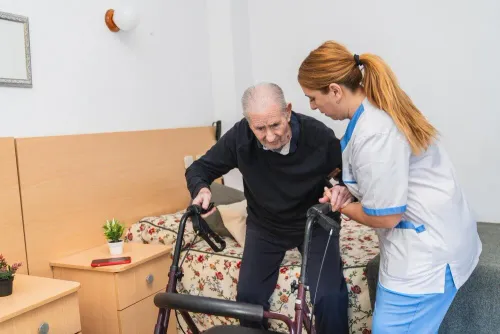
Before helping someone stand, observe bed mobility, sit-to-stand, toileting, transfers, and walking in the actual home. Hemiparesis, neglect, poor balance, visual loss, poor judgment, postural blood-pressure drops, and sedating medicines can defeat a cane or walker.
For a bed-to-chair transfer after stroke, lock both surfaces, move the chair close, remove footrests, and use the technique taught by a physiotherapist. Never pull the weak arm. Support the weak shoulder on a pillow when sitting or lying, and never lift the person by that arm.
Stop walking or exercise for dizziness, chest pain, breathlessness, sudden weakness, or knee buckling. Use short, goal-oriented, repetitive, task-specific practice rather than forceful passive movement.
- Effective fall prevention at home: remove loose rugs and cables, improve lighting, fit non-slip footwear, install grab bars, and keep the call bell within reach.
- For pressure injury prevention, inspect heels, hips, tailbone, elbows, and shoulder blades daily; reposition according to skin condition, mobility, sensation, continence, and mattress support. Cushions do not replace inspection.
- Have each caregiver demonstrate transfers, exercises, and equipment use. Record who assists at each time and the backup plan if that person is unavailable.
Check Caregiver Competence, Equipment, and Escalation Support
Before signing, require a live skills demonstration, not a promise of experience. Caregiver training for stroke patients must include safe transfers, positioning, tube or airway care, medication administration, emergency-equipment use, and recognition of worsening consciousness, breathing, swallowing, or weakness.
Ask the provider to show you:
- The stroke home care nurse’s qualifications and experience with the patient’s deficits.
- A written schedule naming who is responsible for care during each time period.
- A replacement plan if the caregiver becomes ill or unavailable.
- Each item of home healthcare equipment, its purpose, cleaning method, maintenance schedule, and backup supply.
| Service level | Verify before starting | Escalation requirement |
|---|---|---|
| Routine nursing and rehabilitation | Goals, visit frequency, therapist coordination, and caregiver practice between visits | Named clinician for deterioration and missed visits |
| Tube feeding, suction, oxygen, or tracheostomy care | Prescription, clinical indication, settings, consumables, and hands-on training | Written airway or feeding emergency steps and transport plan |
| ICU equipment at home | Ventilator settings, alarm responses, backup power, spare supplies, and continuous trained supervision | 24-hour clinical contact and documented emergency transfer route |
Dhanraj Complete Healthcare Pvt. Ltd should be asked these same questions before arranging nursing, physiotherapy, or equipment support. Equipment delivery alone is not an ICU-at-home plan; choose hospital care when the team cannot provide trained supervision, reliable power, supplies, or rapid escalation.
Frequently asked questions
What should a stroke-specific home care assessment cover?
Assess the stroke date and diagnosis, affected side, mobility, cognition, communication, neglect, visual-field loss, mood, fatigue, executive function, swallowing, continence, vision, medical stability, and emergency-instruction skills.
How should a stroke home care plan change over time?
Create separate goals for the first week, first month, and long term, then update them as mobility, communication, swallowing, medicines, and caregiver capacity change.
How can caregivers manage medicines and blood pressure safely?
Keep one current medicine list with each dose and timing, use a written blood-pressure log, follow the clinician’s target, and escalate readings or symptoms according to the discharge plan rather than changing doses yourself.
When does swallowing require professional assessment?
Arrange a swallowing assessment before oral food, drink, or medicines when the patient coughs during meals, has a wet or gurgly voice, holds food in the mouth, loses weight, or cannot follow safe-swallow instructions.
What prevents falls and other home-care complications after stroke?
Use prescribed mobility aids, remove trip hazards, improve lighting, supervise transfers, follow positioning and exercise instructions, and monitor for pressure injuries, constipation, dehydration, infection, and new neurological symptoms.